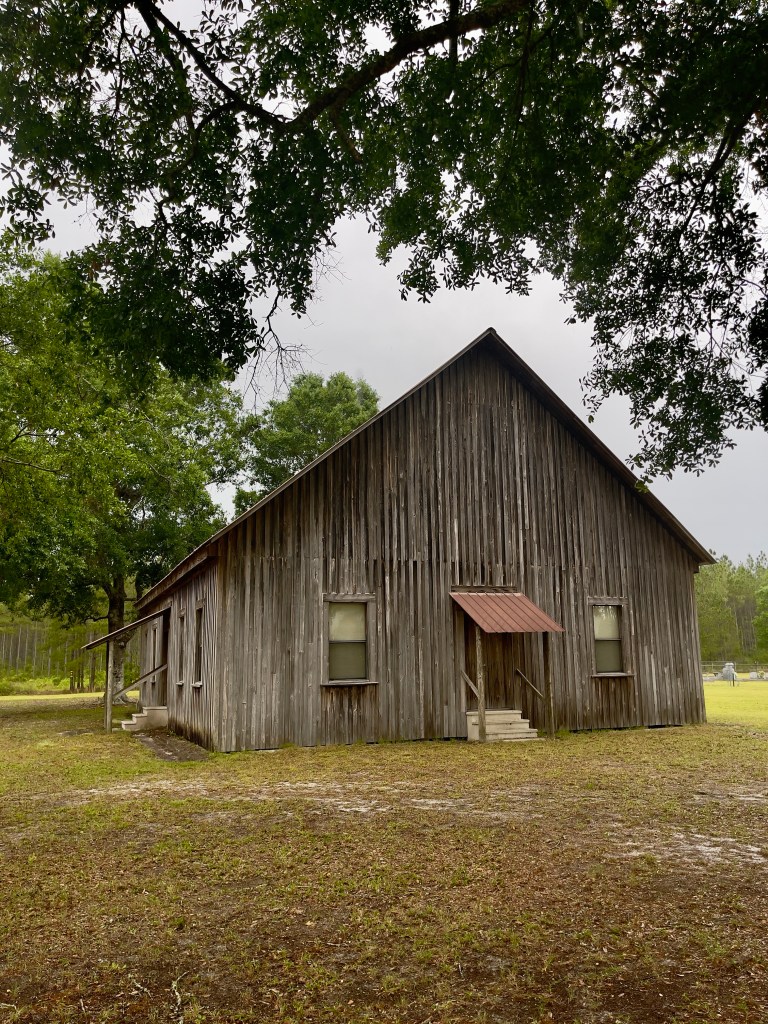
I grew up not 15 minutes from this church and up until recently I a) had no idea it was here and b) had no idea of the all of the fractures that happened within the history of the Southern & Primitive Baptist Churches. What a interesting history lesson this turned out to be…
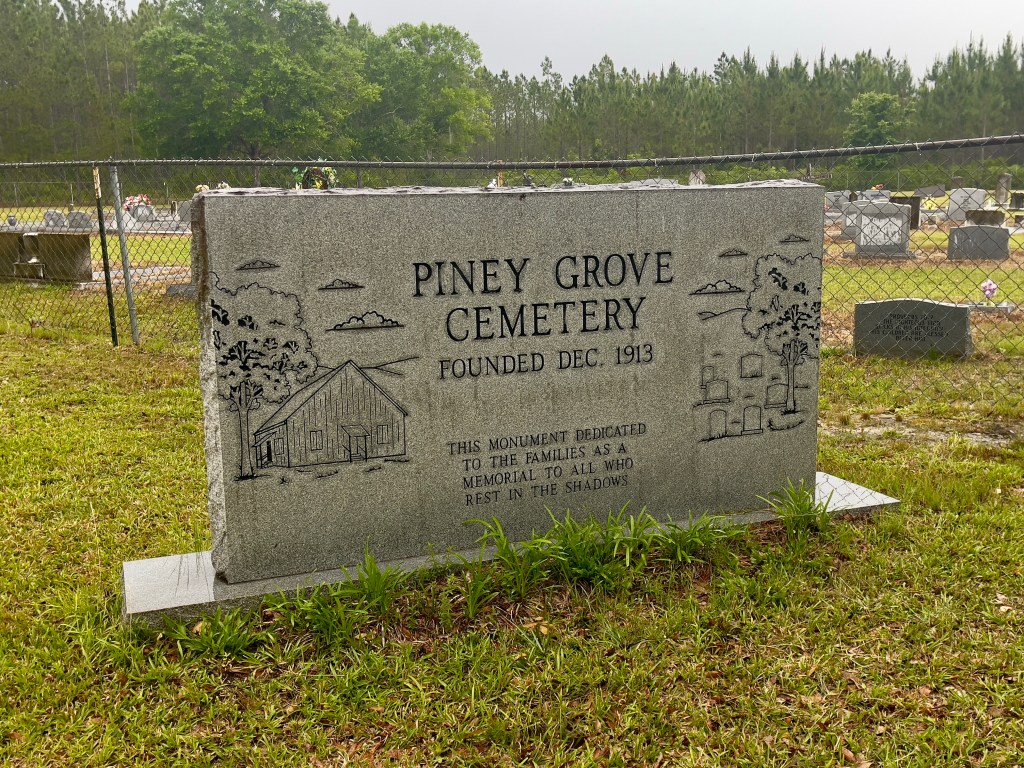
This monument dedicated to the families as a memorial to all that rest in the shadows.
Religion in the south is quite tricky even nowadays and I learned at young age to not ask too many questions about the what, where, why despite being at church a lot. My Papa was a Southern Baptist preacher, the hell & brimstone kinda guy, and disowned his oldest living son for marrying a Catholic. He had considerably mellowed by the time I was in my 20’s and barely blinked an eye when I dated outside of his faith but he was a bulldog about it in his younger years.
And it seems that so were other Southern Baptists and Primitive Baptists! The at one time singular Baptist church fractured over things like mission work, money (duh) and even singing. But let me share what I found:
Piney Grove Primitive Baptist is one of the old Wiregrass Primitive Baptist churches, part of a distinctive group concentrated in the sandy pine and scrub oak lands of southeastern Georgia, northeast Florida, and southeastern Alabama. The name “Wiregrass” comes from the coarse grass native to this region, and the churches here reflect that same hardy simplicity. Primitive Baptists emerged in the 1830s and 1840s from a schism among Baptists over the issue of missions and other practices not directly mentioned in Scripture. Those in favor of missionary work became known as Missionary or Southern Baptists, while those opposed took the name Primitive Baptists—“primitive” meant original or of long ago, not backward, though it has often been misunderstood.
In 1868, another controversy fractured the Primitive Baptists of southeast Georgia. The Georgia Homestead Act allowed individuals to restructure debts after the Civil War, a move some Primitive Baptists considered a breach of contract. The dispute created two factions within the Alabaha River Association: the Crawfordites, led by Elder Reuben Crawford of Shiloh Church, who supported the act, and the Bennettites, led by Elder Richard Bennett of Rome Church, who opposed it. Both factions continued under the Alabaha name, and even today, churches are often described by whether they belonged to the Crawford or Bennett groups. Only four Crawfordite churches remain active, with just three elders among them.
Piney Grove itself was part of these Crawfordite traditions, but eventually suffered its own internal split over the Sacred Harp singing style and other modernization issues. The disagreement left the church without an elder, and with a dwindling membership, it disbanded in 1996. Despite its closure, the building remains, thanks largely to the care of the Thrift family. The sanctuary has survived decades of neglect and even a fire set by vandals, who tried to burn the structure using dry palmetto leaves. Remarkably, the blaze burned out before consuming the heart pine timbers. Today, Piney Grove stands in a good state of preservation—a silent witness to the turbulent history of Primitive Baptists in the Wiregrass region and to the families who fought to keep its memory alive. – from Historic Rural Churches of Georgia
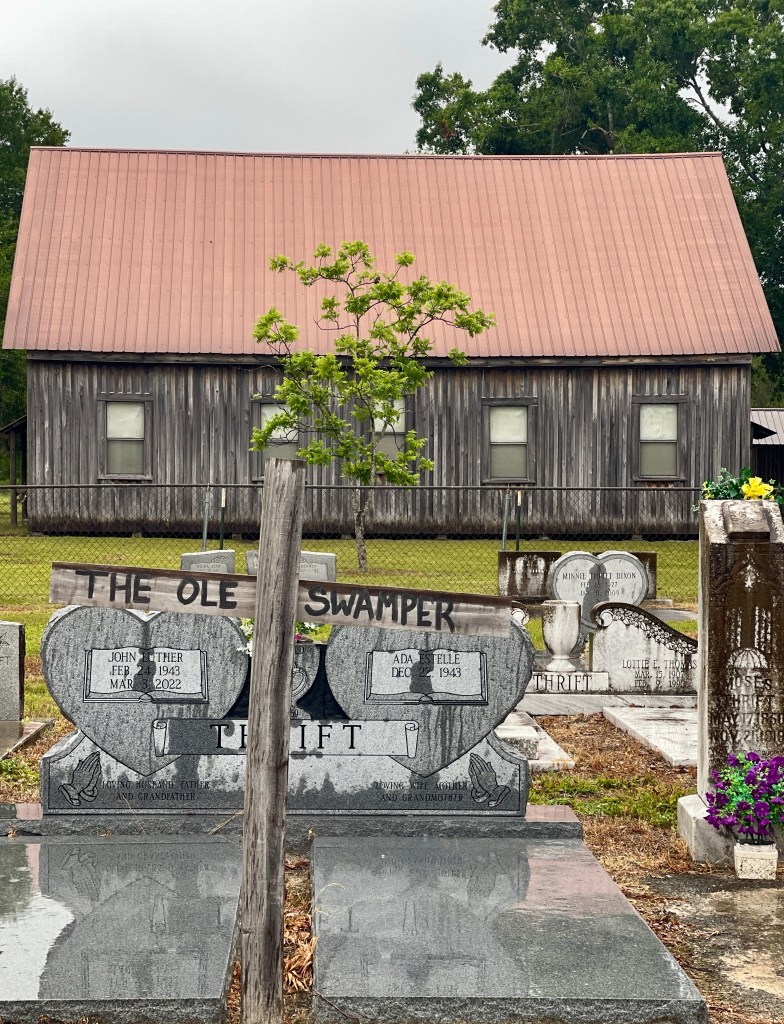
So it’s been almost 30 years since a service has been held but the burials are still happening fairly frequently with new headstones dotting the landscape. As with many rural churches, it seems that Piney Grove is primarily used for the services for the deceased and maybe a Homecoming from time-to-time.
