My Dad’s family lives/lived on Saint Simons Island just south of Savannah so I often heard tales about the beautiful and mysterious Bonaventure Cemetery. And, being interested in ghostly or morbid tales of the past, I made sure to learn about some of the stories that were often told about the residents within. In particular, there were a handful that have remained shining bright in my memory! Those featured the sad historic tales of Corrine and Gracie, and a more recent loss of the Savannah community with Julie. Plus the usual backstory of one of the nation’s last remaining grave bells.
‘Lost Love’ lawton


Corinne Elliott Lawton’s 2nd resting site is one of the most visited graves at Bonaventure Cemetery but it’s primarily because of local lore that is not quite based in truth.
The ‘ghostly story’ is that Corinne fell in love with a man who was below her station in society. Her family didn’t accept him, refused to give their blessing and was planning to force her to marry a wealthy man she did not love.
So, in true dramatic storytelling fashion, Corinne donned her wedding dress on the morning of her arranged marriage but then decided to race to the river on horseback and drown herself as an escape. It’s said that her spirit has been seen wandering the banks of the river as she looks for her lost love…
The truth however is that Corinne took to her bed with a slight illness that quickly became life-threatening and she died at her home while surrounded by her family. During that time (1877) the Yellow Fever endemic was raging in Savannah and it’s likely that Corinne was one of its many victims.
If you noticed that I mentioned in the first paragraph that this was the second gravesite of Corinne? She was originally buried in Laurel Grove North but her body was re-interred at Bonaventure Cemetery right on the bluff. When she was moved there were no other monuments that existed in the family plot and that probably gave more fuel to the fire of her untrue story since it could appear that the family distanced themselves from her.
But she was most definitely loved and missed by her parents and many who knew her. She was eventually immortalized with a life-sized statue bearing her likeness that was commission by her bereaved family and designed by Italian sculptor Benedetto Civiletti. Her epitaph reads “Allured to brighter worlds, and led the way.“
Little Gracie
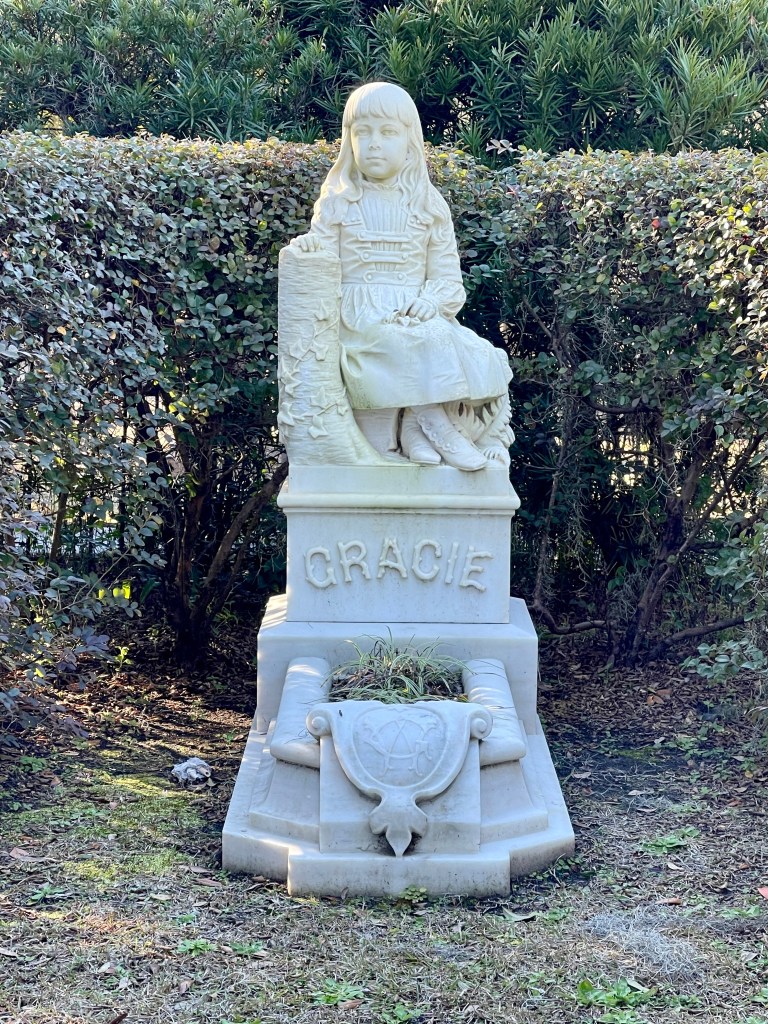
The final resting place of Little Gracie Watson, who died of pneumonia at the age of six just two days before Easter in 1889, has been the most visited grave in the cemetery for over 100 years.
She grew up at her parent’s hotel aka Pulaski Hotel on Johnson Square and was considered the official unofficial greeter of the locale. The nearby green space at the square was also another favorite spot of hers and she was often seen (as still is according to some) playing amongst the trees…
Her parents commissioned John Walz (he became the iconic funerary and city sculptor of Savannah but more about him another time) to create a statue for her grave at Bonaventure and folks have flocked to see the lifelike marble sculpture since it was installed. It became a tradition to bring her Christmas gifts and there are many tales from the older generations that talk about the treks they took to visit her grave to see if her statue cried real tears or not.
At some point her popularity grew past the point of everyone being respectful and veered directly into oh-shit-now-there-is-damage. Her nose was broken, and the greenery around her grave showed wear and tear. Eventually repairs were made and a fence was put up to protect her visage.
Today you still find gifts left for her at the fence surrounding her grave but it seems that the ghost of Little Gracie doesn’t spend much time at Bonaventure and instead prefers to visit her old haunts. A little girl in an antique white dress has been seen at Johnson Square at all hours of the night and people swear that it’s Gracie. And shortly after her death many employees of the Pulaski Hotel, the one where she lived and died, could hear Gracie’s laughter ringing in the hallways.
The Grave bell


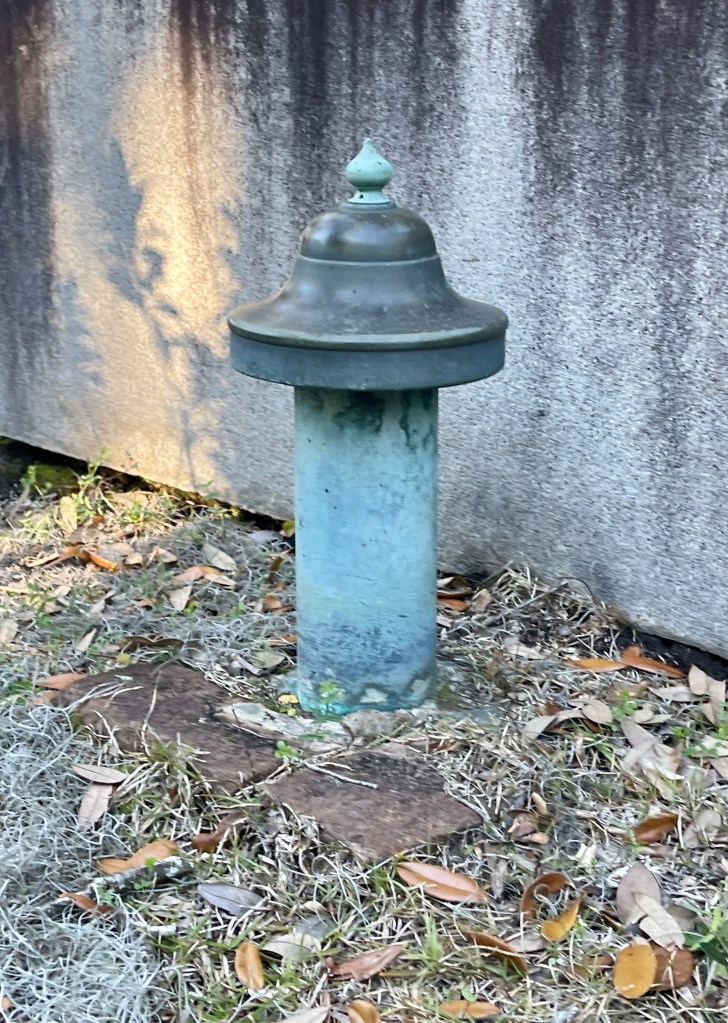
I spy with my little eye…a grave bell! The last surviving one in Bonaventure Cemetery and the only one I’ve ever seen in person.
We’ve all heard the sayings “dead ringer” and “saved by the bell” but I didn’t know they originated from taphophobia – the fear of being buried alive – and this type cemetery gadgetry. Learn something new every day!
The Victorian era was considered the zenith for such things and many a wealthy person had these types of bells at the ready. A string was attached to fingers or toes, or in the case of Charles Mills, whose grave is pictured here, fingers and toes, and if a person was accidentally buried alive then movement would ring the bell and signal graveyard staff. There were also air tubes and other methods of alerting someone that the dead ‘weren’t quite dead’ but it appears that the bell was the most popular method.
After the science of embalming became the prevalent thing of the time, these grave bells faded into obscurity. The only reason that the Mills family plot still has one is because it’s made of bronze and that wasn’t a coveted metal during times of war when tin, copper and others were taken to build artillery.
Just a few more things about Charles Mills…
He was so afraid of being buried alive that not only did he have the bell installed but he went even further. His wake lasted TEN DAYS during the month of April in the late 1880’s before he was buried. Uh, not a good thing for a southern spring but I guess better than high summer. And he wasn’t so much as buried but placed in the crypt where he could get air via a ventilation system of sorts. He definitely thought of every detail but none of it was needed in the long run. Mills stayed dead the first time and it was most definitely not a coma, paralysis or any of the other possibilities of why someone might be playing possum (of sorts).
The Eternal Jogger
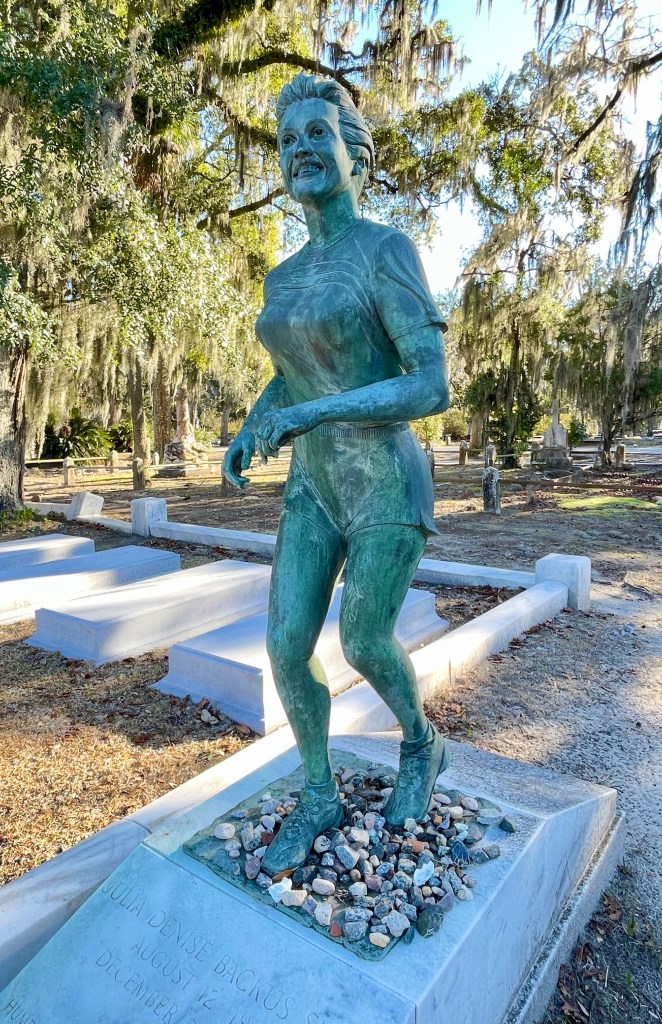
Julia Denise Backus Smith was considered a prominent member of Savannah society – Jr. League contributor, running club creator, commissioner for her district, advocate and more. Tragically, she died by suicide in 2003 at the age of 57. **
Now she’s forever captured by a life-sized bronze sculpture that has gone green in the humid salty air from the nearby Savannah River. Her modern and unique gravesite draws just as many visitors as the historic ones. And look at all the lovely rocks that have been left for her! That’s because of her epitaph…
“Humble, Brave, Beautiful, Determined. Deep in her Faith. Julie served her fellow man regardless of race, walk or worth. Julie was her family’s “rock” She’s sorely missed, dearly cherished.
Savannah’s Fastest Female Runner Marathoner Twenty One Races, Two Mountain Ones Last Marathon at Age Fifty Five Always Setting Her Goals High Julie Excelled in Each Endeavor.
Educator, County Commissioner, Telfair Museum Trustee, Historic Savannah Guide, Advocate, Trail Blazer, AAU Swimmer, Sail Enthusiast, Beauty Queen.“
I love this tribute to her – a moment in motion, smiling, doing something she loved – that so celebrates the way she lived.
