I’m back for another chapter from my visit to Marietta and the city owned cemetery that is currently undergoing continued restoration. If you want a refresher on the previous posts and their topics then you can find them here and here. Check ‘em if you can because there are topics like the finding of five fisk coffins (say that five times real fast), the sad tale of a woman dressed in all black and even a story about an amputated leg buried with honors. They’re all there!
But out of all the stories of Marietta City Cemetery the most well known, and the focal point for what is considered one of the most notorious and controversial court cases in Southern history, belongs to Mary Phagan. Her violent death sparked world-wide controversy that is still discussed today…
Please note there are topics such as rape, murder, lynch mobs, anti-semitism, etc, discussed in the paragraphs below…

Little Mary Phagan
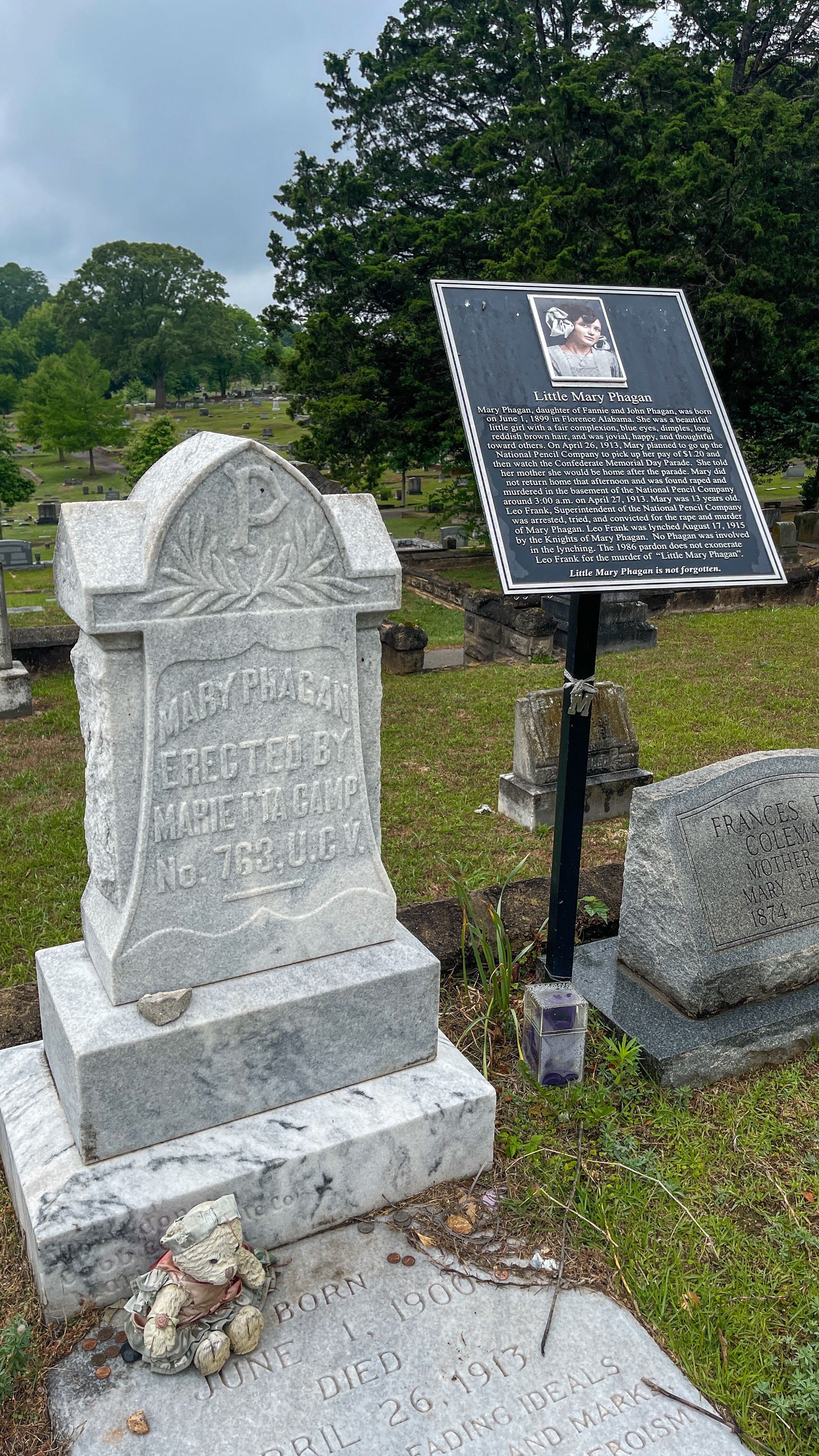
Mary Phagan, daughter of Fannie and John Phagan, was born on June 1, 1899 in Florence Alabama. She was a beautiful little girl with a fair complexion, blue eyes, dimples, long reddish brown hair, and was jovial, happy, and thoughtful toward others. On April 26, 1913, Mary planned to go up the National Pencil Company to pick up her pay of $1.20 and then watch the Confederate Memorial Day Parade. She told her mother she would be home after the parade. Mary did not return home that afternoon and was found raped and murdered in the basement of the National Pencil Company around 3:00 a.m. on April 27, 1913. Mary was 13 years old. Leo Frank, Superintendent of the National Pencil Company was arrested, tried, and convicted for the rape and murder of Mary Phagan. Leo Frank was lynched August 17, 1915 by the Knights of Mary Phagan. No Phagan was involved in the lynching. The 1986 pardon does not exonerate Leo Frank for the murder of “Little Mary Phagan”.
Little Mary Phagan is not forgotten.
The trial of Leo Frank took over a month and was widely sensationalized locally, nationally and even globally due to a number of issues. It was fraught with racism, anti-semitism, Anti-Northernism, sordid details, disputed lawyer connections, and more. Even the Governor himself, having commuted Frank’s sentence from death to life in prison, was the target of community rage (hanging effigies were frequently parade on the Governor’s front lawn by angry residents) and he had to leave Georgia under police protection. Frank was taken from Milledgeville Prison Farm in 1915 and hung by a lynch mob in Marietta not far from where the Phagan family resided.
The events that followed one of the most sensational trials of the century – Frank’s conviction, the commutation of his death sentence and his subsequent lynching – polarized Atlanta. It captured the attention and sympathies of national and international audiences, and launched far-reaching social, legal and cultural changes.
The question remains, was justice served?
Leo Frank received justice in that he had a trial before a jury. But were the trial proceedings just? Was justice derailed when both his sentence to hang and its commutation to life imprisonment by Georgia’s governor were overthrown by a vigilante lynch mob? If, as Governor John M. Slaton and many others believed, there was reasonable doubt about Frank’s guilt and that he might have been falsely accused before a court of law, then someone else murdered Mary Phagan. If that is the case, then the true killer was never punished. Source – The Breman
You can read more about the trial here, here and here to see why it’s still discussed in law educational courses…


We will never know if Frank really murdered Mary or if it was one of the other 4 men who were suspects at one point in time. And while her death was weaponized by many men in the community in order to push hateful rhetoric, the fact remains that a young girl, a child, lost her life in a terrible way and she deserves to be mourned and recognized. There are songs, books and theories galore about young Mary (here’s a link to a banjo session where he not only plays the song but discusses the story and offers suggestions for other musical versions), and she remains a subject of sympathetic interest to visitors at the cemetery. Her grave is adorned with so many tokens and gravegoods – stuffed critters, coins, rocks, jewelry and ribbons. It’s been over a hundred years and Mary’s memory is still alive at Marietta City Cemetery…
Speaking of cemeteries, which of course I always do here of course, Leo Frank is buried in Glendale, NY and you can view his gravestone here. His grave is also frequently visited and there’s a memorial marker nearby that outlines the events that led to his death and murder.