
One of the questions I get asked the most, right behind the questions of are you comfortable with death? and do you yourself want to be buried? (strong no to both but that’s for another time) is what is your favorite cemetery? Y’all, I cannot answer that with one place! No way. It’s just not possible for me to pick a favorite anything. But I do have to say that Athens has some of the most interesting, heartbreaking and just-so-dang-beautiful cemeteries around. I might be biased because I live here (def, a bit) but it’s also true.
So, if you’re visiting the Classic City and want to explore the most accessible and historic cemeteries then this is a good start. You should also pop by the Historic Athens Welcome Center or the ACC Library to find my brochures (but you can download them here and here) and a bunch of other helpful info to help you on journeys.
Gospel Pilgrim


Founded in 1882, currently on the National Historic Register and the final resting place of many of the city’s black community, Gospel Pilgrim sadly sits mostly neglected since being declared officially abandoned in 2002.
Efforts are made by the city and volunteer organizations (more on that to come!) to clean up the area, and there are now walking paths but vines and overgrowth remain a continuing problem without consistent and extensive care.
The cemetery is home to world famous folk quilt maker Harriet Powers and the USPS just released a commemorative stamp in her honor. You can read more about Powers in a post I made about her memorial dedication here.
The ADP (Athens Death Project) is no longer a current project but they remain, in MHO, one of the best sources for general historical information about this cemetery. Go here.
I hope to update soon with information about a local non-profit centered around not only improving the cemetery’s accessibility but acknowledging the surrounding community that has tried to keep the memory of the cemetery alive.
Oconee Hill Cemetery


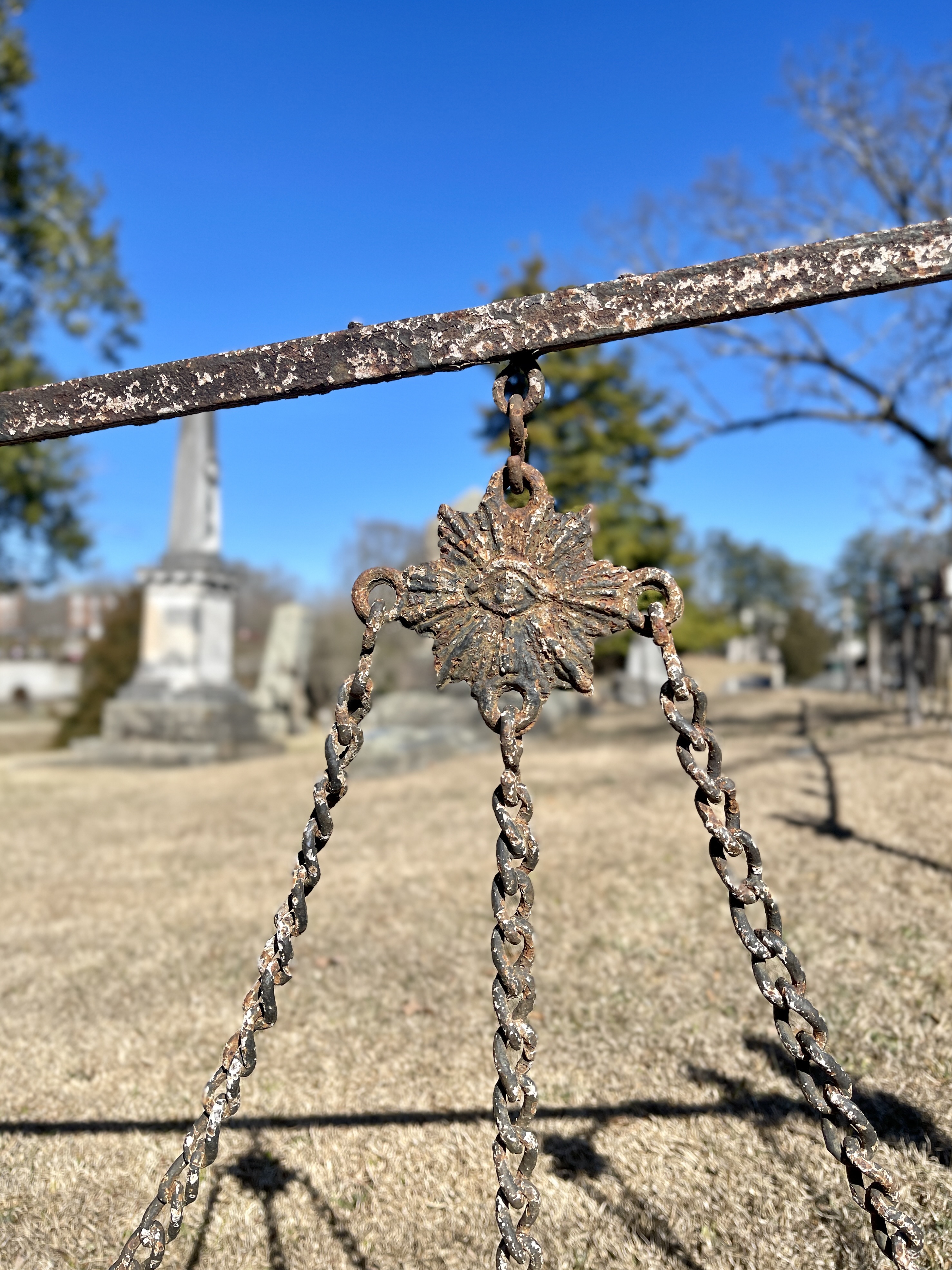
Established in 1856 and now listed on the National Register of Historic Places, Oconee Hill is significant for its landscape architecture, decorative funerary markers, distinctive cast-iron fencing, a rare through-truss bridge, and a Sexton’s House of architectural significance. The grassy and rolling terrain with woods, flowing water and scenic vistas makes Oconee Hill a pleasant place to visit and stroll among the graves of many notable Georgians including governors, University presidents, veterans, and Congressmen. And there are sections for the Jewish congregation and their spouses/partners of other faiths, a section for mill workers, one for paupers, and an African-American section that sits in a low lying area that has washed most of those stones/memorials away.
In the oldest sections you’ll find names that are very familiar to an Athens dweller such as Lumpkin, Barrow and Aderhold. Crawford Long, the inventor of anesthesia, and Ben Epps, the first to build and fly an airplane in Georgia, are also buried here.
In the new section across the river you’ll find the grave of Ricky Wilson. Wilson was a founding member of the B-52s , and his pyramid shaped grave still sees a steady stream of visitors who leave retro-themed tokens aka grave goods, like mini lava lamp keychains, in his honor.
This is still an active cemetery with a much newer section across the bridge that can see several burials a week. Please be aware of cemetery etiquette when visiting.
Take a virtual tour on the website or book a private tour with Luis.
Brooklyn Cemetery


Athens’ oldest African-American cemetery, Brooklyn Cemetery. This was the final resting place for the local Black community of the Brooklyn/Hawthorne area and beyond. The first burials took place in the 1880s and the cemetery, called Bethlehem Cemetery at the time, grew rapidly and remained active until the 1950s. After that time the burials began to slow, and the land fell into a state of neglect. Recent efforts of The Friends of Brookly Cemetery have seen that change as the cemetery has been mostly cleared and lost plot restoration has begun. In the last decade over 1,100 graves have been identified and marked, and unique gravestones have been uncovered.
One of those unique gravestones was crafted by Atlanta outsider artist Eldren E.M. Bailey. Bailey was a prolific outsider artist who created yard art, structural art within his home, and, of course, gravestones for all African American communities across the state of Georgia. His work includes a hand-lettered plaster front inscribed with symbols from across the world with the honorific “Mr.,” “Mrs.,” and “Miss” as a way to show respect to the deceased. Historically, the Black community was never allowed to use those honorifics, so Bailey was sure to include them on every stone he crafted.
In the spirit of keeping it local, it’s also important to note that the Brooklyn Cemetery west side entrance now boasts an ornate gate created by the renowned Athens metal sculptor Harold Rittenberry. Dedicated in 2017, the gate is interwoven with a number of images that symbolize differing stories. You’ll see a tree for knowledge and life, birds ascending for freedom and transition, and much more. Rittenberry’s work for the cemetery has special meaning since he often played in the cemetery as a child.
Spaulding Cemetery

During the Jim Crow era this cemetery was considered one of the most important Black cemeteries in Athens alongside Brooklyn and Gospel Pilgrim. Located on the rapidly gentrifying east side of downtown, it is now a combination of completely overgrown (middle) and cleared (either end). There a number of large monuments hidden in the middle of the cemetery that have some classic funerary art symbolism as well as number of vernacular styled stones like the one above for the brothers Davis.
The smallest of the three historic cemeteries, it seems to be the most currently active with funerals and remembrance days so please practice cemetery etiquette when visiting.
Old Athens Cemetery aka Jackson St Cemetery
Believed to have open to public in the late 1700s, this cemetery is located on what is now part of UGA main campus. Burials took place here to the point of overcrowding and there was little official recording keeping and no official sexton to handle the information as time passed.
In 1935 UGA built Baldwin Hall on land which abuts the cemetery. They did so knowing that there were probably a number of graves on the property but they did it anyway. When an expansion of the Hall begin in 2015 there were 150 gravesites found, and the project was halted as a result. A number of remains were identified as African-American individuals and were most likely former slaves. This event and UGAs subsequent handling of queries and actions began a discussion about the University’s history of slavery. Accusations of continued racism, bullying and intimidation were lobbed by faculty, staff and activists, and the news reached nationwide status. The controversy still reigns today.
To read more: Institute for African American Studies, Red & Black, another Red & Black, Flagpole, Medium, extensively linked eHistory post (obviously this list is not exhaustive)
Tomb of UGAS
Did you know that Sanford Stadium, located right across the street from Oconee Hill Cemetery, is a cemetery of sorts itself? It has a one-of-a-kind mausoleum beneath its stands? It’s no secret that everyone who likes college football is familiar with UGA’s cute and wrinkly English bulldog mascot Uga. We’re now at number 11 (XI) in the lineage, and for those wondering what happened to Ugas 1–10 after they passed on, the answer is that they’re buried in a wall mausoleum close to Gate 9 of the stadium. While alive the bulldogs enjoy an air-conditioned dog house, custom-made jerseys and a pampered lifestyle. In death each has a specialized epitaph plaque placed on their marble tombs. They read the specific name and dates of each Uga as well as their monikers like “Damn Good Dog” and “A Big Dog For A Big Job, And He Handled It Well.”
UGA is the only major college that buries its mascot within the boundaries of a stadium. Thousands of visitors visit the tombs every year and often leave grave goods such as dog treats and other trinkets. Before each home game there are flowers laid at the tomb by the university to honor the spirit of the dogs… and the Dawgs.
Other Cemeteries
There are more than 80 documented cemeteries in the Athens-Clarke County area so I obviously couldn’t cover them all…at least in one post. I’m adding spots regularly to my google maps so be sure to take a look there and then explore on your own.
Need some further guidance on things? Don’t hesitate to contact me.
And if you want to see the oddities of Athens – moontrees, rainbow forests and more – then be sure to visit my other blog Another Southern Roadside Attraction.