
I’ve been slowly learning about spiritualist movements over the last few years and I’ve always been interested in a dash of roadside-sideshow-theatrical flavor to my stories. So it’s seems only natural that when I stumbled across The Georgia Wonders, I was hooked!
Brief summary: The Georgia Wonders were a group of women who seemed to have abilities beyond the average mortal, and many claimed that they had these powers thanks solely to supernatural elements.

First up is Lulu Hurst, known as the original Georgia Wonder. Born 1869, struck by lightning in 1882 and already touring in 1883, “Laughing Lulu” was known not only for her ability of moving objects but also for her feats of seemingly unnatural strength.
When Lulu took to the stage it appeared as of it chairs, canes and umbrellas could levitate and dance in her presence, seemingly propelled by an unseen force with just a touch.
Her most startling performances involved a volunteer, often a strong man, who would hold a cane out in front of him. The moment Lulu laid her hands on it, maintaining balance became a formidable and impossible challenge. Those burly dude volunteers were often pulled around like rag dolls, occasionally ending up on the floor. As you can imagine, this type of act gained Lulu immense popularity throughout Georgia, the south and beyond.
However, things went sour very quickly. Overwhelmed by being one of the most famous women in Americas, tired from traveling and being studied by scientists, and saddened by a slew of copycats who were tarnishing the act’s reputation, Lulu decided to call it quits. She married her manager at 16, retired with some considerable wealth and lived a quiet life in Madison, Georgia.
She refrained from discussing her illustrious and unusual career until 1897, when she published an autobiography that garnered significant attention and unveiled some previously unknown information. It offered a glimpse into her travels, her life at the time and her methods, but afterwards she never publicly spoke about of it again.
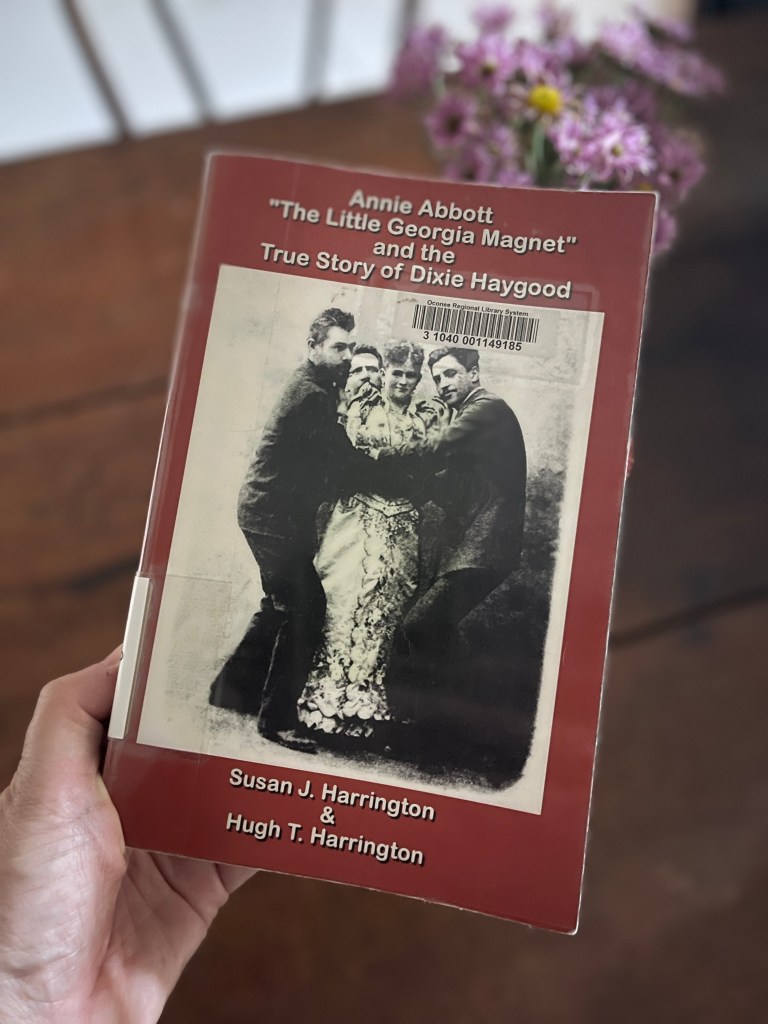
Her fame inspired many imitators but the most notable performer to emerge was Annie Abbott (real name Dixie Haygood) who became known as the Little Georgia Magnet.

Dixie Haygood aka Annie Abbott was not the first stage show of this nature as she’d actually been inspired by Hurst, but Haygood/Abbott became much more popular and well-known than any other act. Maybe even more so than Lulu Hurst thanks in part to her early retirement.
After marrying a local marshall Haygood, Dixie (I’m just going to call her by her first name from here on) took her show on the road with increasing success. She ramped things up after her husband was killed in the line of duty and she became the sole earner of the household with 3 small children to feed.
Dixie was a small woman so her shows seemed even more dramatic when grown men couldn’t lift her off the ground due to her ‘magnetism.’ She also leaned in to an air of mystery with headaches after performances and public calls for cures of her ailments. She never commented on how her feats were accomplished even when they were exposed by scientists as force deflection. Dixie kept her chin up and kept on moving because these types of articles only fueled more speculation. No such thing as bad publicity and all that…

in Milledgeville, Georgia.
Dixie was invited to perform in London and her success there led to a two-year European tour where she performed for numerous heads of state including Kaiser Wilhelm II of the German Empire, Emperor Franz Josef I of Austria-Hungary, and Tsar Alexander III of the Russian Empire. Even Harry Houdini, famously known as a debunker of spiritualism and all things uncanny, gave Dixie a backhanded compliment about being the best of the Hurst imitators.
Eventually Dixie retired, but even years after that stories about her continued to swirl thanks in part to imitators that actually stole her name outright in their acts. The later years are a bit muddy because it’s a bit confusing if it was the true Dixie or not!
Read more about Milledgeville here and here.
Does anyone have a favorite book on spiritualism that they’d like to recommend? I’ve just requested The Darkened Room: Women, Power, and Spiritualism in Late Victorian England from my local library but I’d love to hear your suggestions.